

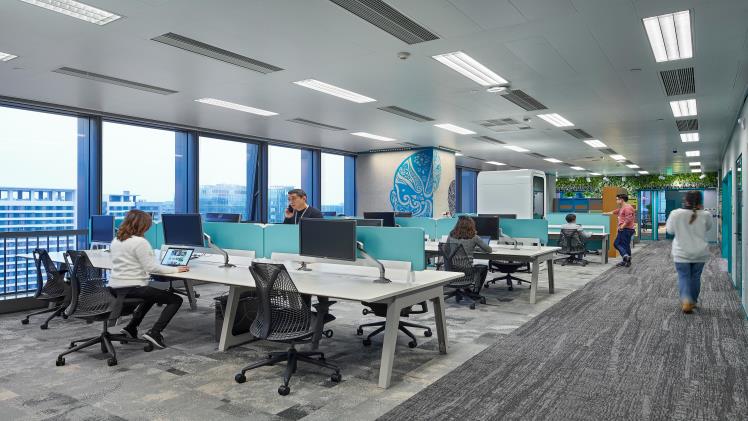
Post covid pandemic, there has been a dramatic shift in the office market space. Due to lockdowns in the past, many professionals had to work from home for a significant period. Post this period there was a sudden spike among businesses to have workspaces in remote locations. This led to an ecosystem that led businesses to find this setup effective. However, many aspects of work, such as team meetings and collaboration, often require the physical presence of professionals. In the meantime, tier 2 cities are being developed at a rapid pace to showcase as a valuable location for business operations. Hence there has been an interest among entrepreneurs to lease office spaces in tier-2 cities. It becomes essential to understand how tier 2 cities have become a preferred destination for businesses.
Rise of Hybrid Model in Enterprises
The hub-and-spoke model of work has become mainstream in the post-pandemic era. According to this model, the professional works in a hybrid manner, i.e., for some days of the week as remote work and the rest at the office. As a result, it is a common model for tier 2 cities that work as emerging IT hubs. Based on reports by consultancy firms, Indore is strongly emerging as a valuable IT hub. Accordingly, there have been enterprises that are seeking office space in Indore and other tier 2 cities. This setup provides a dual advantage; it ensures businesses are able to retain talented workforce who reside in tier 2 cities. Along with this, remote access-based technologies provide seamless communication and coordination for enterprises that are headquartered in tier 1 or metropolitan cities.
Low cost
It is no surprise that the expenses incurred in setting up workspaces in tier-2 cities are significantly lower than its tier-1 counterparts. Whether it is rental costs or operational expenses, businesses can ensure they can work on a comfortable budget. Conversely, the government has also introduced several schemes and subsidies to promote enterprises to lease flexible offices in tier 2 cities. This strategy also reduces locomotion costs for several industries. For instance, textile manufacturing industries that have office space in Ahmedabad can ensure proper coordination in terms of logistics and transportation. Ahmedabad, which is known as the “Manchester of the East,” is a prominent textile hub in India. Thus, textile-based enterprises could gain access to potential clients, which would be valuable for business.
Infrastructural development projects
In recent years the regional authorities based in tier 2 cites have been focused on infrastructural development. The Tier 2 cities in India have seen significant development in terms of roads and other transformational facilities. As a result, it has become very favorable to have workspaces in tier-2 cities. Along with this, there are several commercial centers being developed that are expected to be accessible by clients and the workforce. Many enterprises have already opened up flexible office space in tier 2 cities. These special economic zones are expected to be a game changer for the Indian economy. This rapid development would attract significant investments that would promote tier 2 cities as a preferable destination for business.
Quality of life
Away from the hustle and bustle of metropolitan cities. The Tier 2 cities provide lives which ensure an improved standard of living. In the first place, there are lower pollution levels and increased forms of mobility. Hence, it comes as no surprise there is a recent trend where professionals prefer to have a workspace in proximity to their hometown in tier 2 cities. According to consultancy firms such as E & Y, this trend is expected to grow.
As per the India Skills Report 2023, tier 2 cities are emerging to become centers for specialized industry-specific requirements. Based on HR reports of these enterprises, the attrition rate of these office spaces is seen to be 10% lower in comparison to tier 1 cities.
Potential Market and first mover advantage
The rise of managed office space presents advantages and opportunities for enterprises. With a huge untapped market potential in these cities and a rising number of employment opportunities, the sky is the limit. It is estimated that this coworking space will expand drastically in the coming years. This market growth will cater to the flexible work requirements of the enterprises. Hence the businesses are seeking to lease managed office spaces that consist of all the necessary amenities.
Conclusion
Based upon the aforementioned aspects, it can be said that tier 2 cities will continue to thrive as one of the top locations for enterprises to lease a workspace. However, these businesses seek to ensure that the overall standard of the workspace is par to the tier 1 cities. For such solutions, it is advisable for them to consult a platform to obtain robust managed office spaces. These office spaces are customized according to the business requirements. By consulting these platforms, one can lease office space in commercially popular tier 2 cities such as Ahmedabad, Indore, Jaipur and so on. With the advantages of renting a workspace in tier 2 cities, enterprises can ensure optimum facilitation of business growth.
